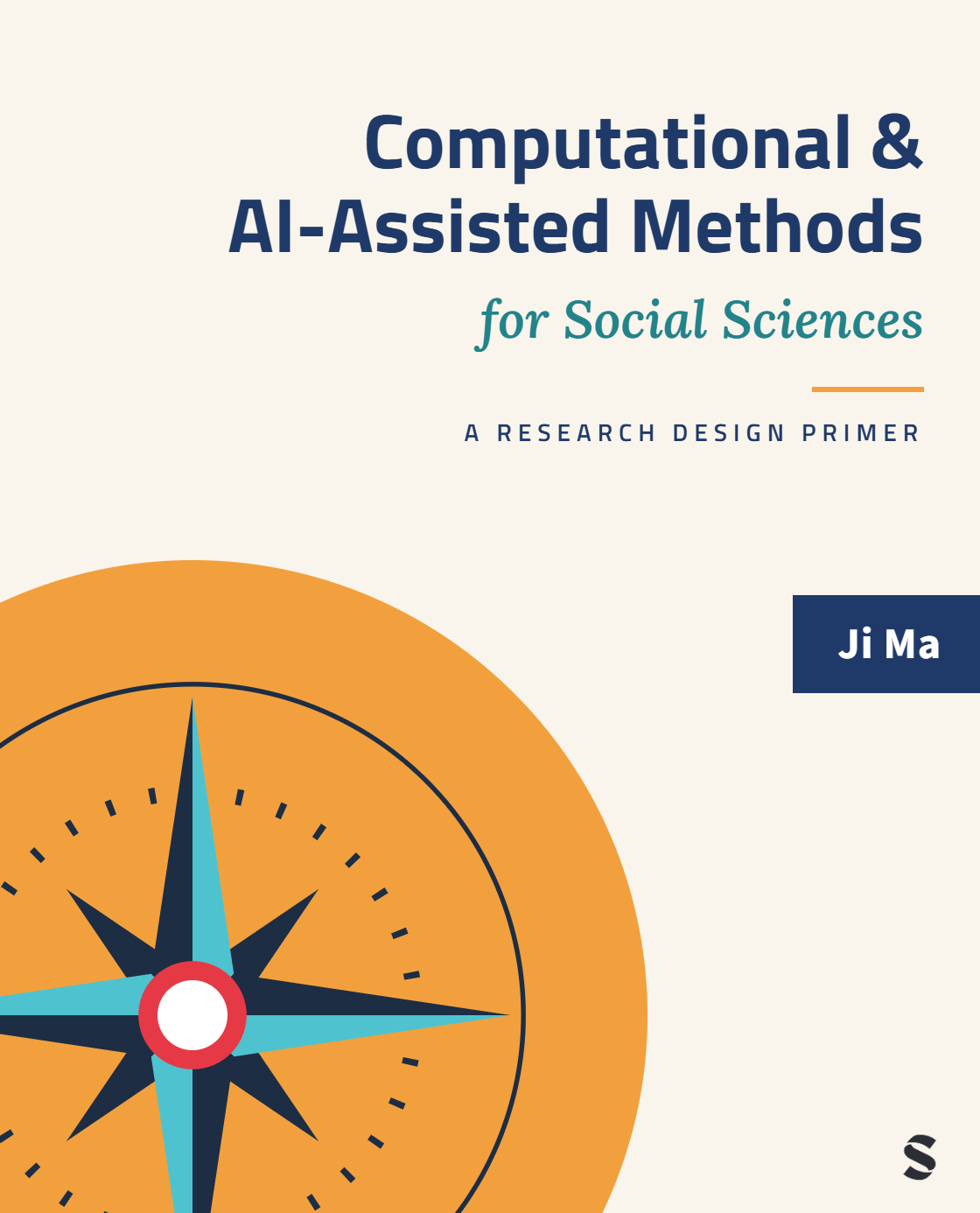
Computational & AI-Assisted Methods for Social Sciences
Companion website to the research design primer by Ji Ma
If you are working through a chapter, start with its assignment and examples. If you need to run code for the first time, start with the setup guide. The primers, annotated studies, and worked notebooks are free to read and download without an account.
Jump to your chapter
Each chapter page brings together its assignment and relevant primers, examples, tools, or studies. Chapters 1, 11, and 12 draw on the shared materials rather than separate pages; Chapter materials explains how the theory and exercise chapters connect.
About the book
Computational & AI-Assisted Methods for Social Sciences: A Research Design Primer (Ji Ma, SAGE, forthcoming) approaches computational and AI-assisted methods through research design. Four stages organize the book: data management, concept representation, data analysis, and scientific communication. You apply them to a literature dataset from your own field, explaining your choices and checking the results, including those produced with AI.
The book is written for graduate students and researchers in the social sciences. You can begin the conceptual chapters without a programming background; the setup guide and primers help you prepare for the exercises.
Every exercise was tested by five cohorts of graduate students, and the studies database was compiled with three research assistants. They are thanked by name on the About page.
| What it does | Where it lives | |
|---|---|---|
| Theory chapters (1, 2, 3, 5, 7, 9, 11, 12) | Examine what a measure assumes, which claims a method supports, and what evidence would give you confidence in a result | The book |
| Exercise chapters (4, 6, 8, 10) | Apply those ideas to a dataset from your field, from the first retrieval to the final report | The book |
| This site | Find setup instructions, primers, tool lists, templates, and datasets as the software changes | Online |
The book explains research tasks independently of a programming language. This site mostly uses Python to show how a task can be implemented. You can adapt the approach to your own tools, checking that they support the operations the exercise requires.
The For researchers page introduces the book’s arguments and frameworks; course fit and a possible fifteen-week schedule are on For instructors.
Start where you are
New to computational work?
Start with a small table in a browser notebook, then work through the primers you need: text data, supervised learning, and prompting.
Teaching with the book?
Plan a course with the chapter decks, a suggested schedule, and assessment guidance for students using AI. The setup guide and primers support students who need more preparation.
Using the book in your research?
Find the chapters behind eight methodological claims and choose a framework for a decision in your own study.
The library
- CSS Empirical Studies Database: 122 published computational studies, annotated by design stage, searchable and downloadable.
- Worked notebooks and data: three notebooks with saved outputs, plus sample network data for Chapter 8.
- Tool guides: data management, automated coding, analysis, and communication, revised as software changes.
- Resource list: where to go beyond this book.
When a model codes a document, read the passage behind its label. When it drafts code or proposes a data structure, try the procedure on a record you know. The chapter exercises ask you to investigate disagreements and errors before using the results.